

Support during early childhood has long-term effects on health, education, and family stability.
Brazil’s Criança Feliz program proves that structured home visits and public coordination can deliver those benefits at national scale.
This overview highlights key elements of the program that other countries can adapt to reach vulnerable families effectively.
Overview of Criança Feliz
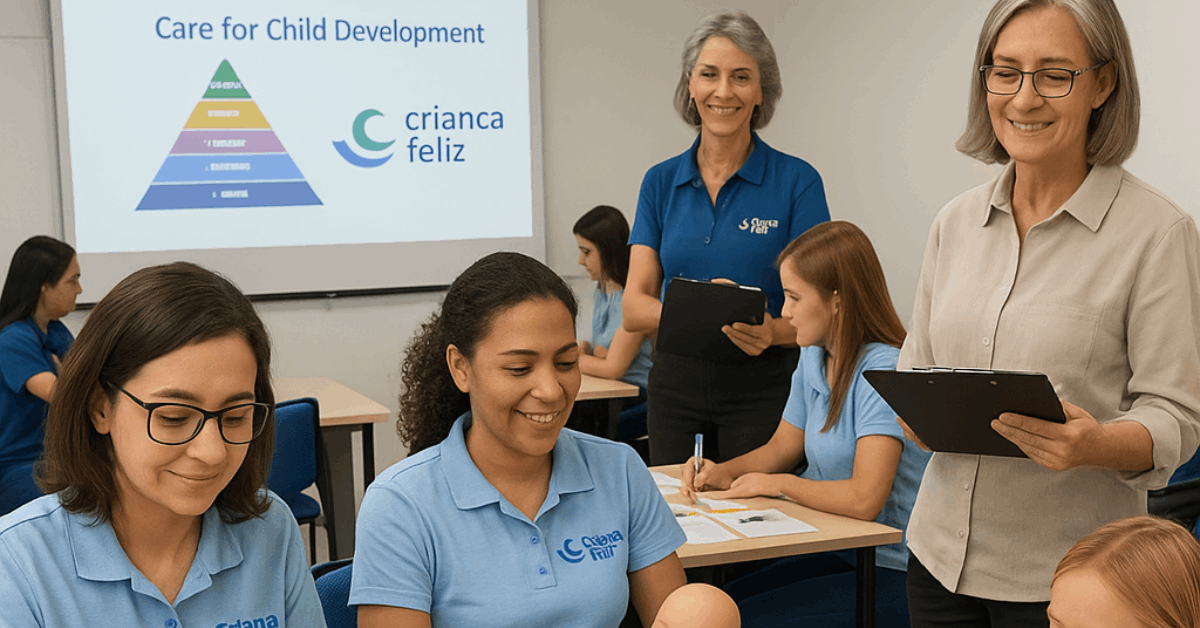
Brazil’s Criança Feliz stands among the largest early-childhood home-visiting initiatives worldwide.
The program, launched in 2016 and embedded in Brazil’s Unified Social Assistance System (SUAS), serves families facing economic or social vulnerability.
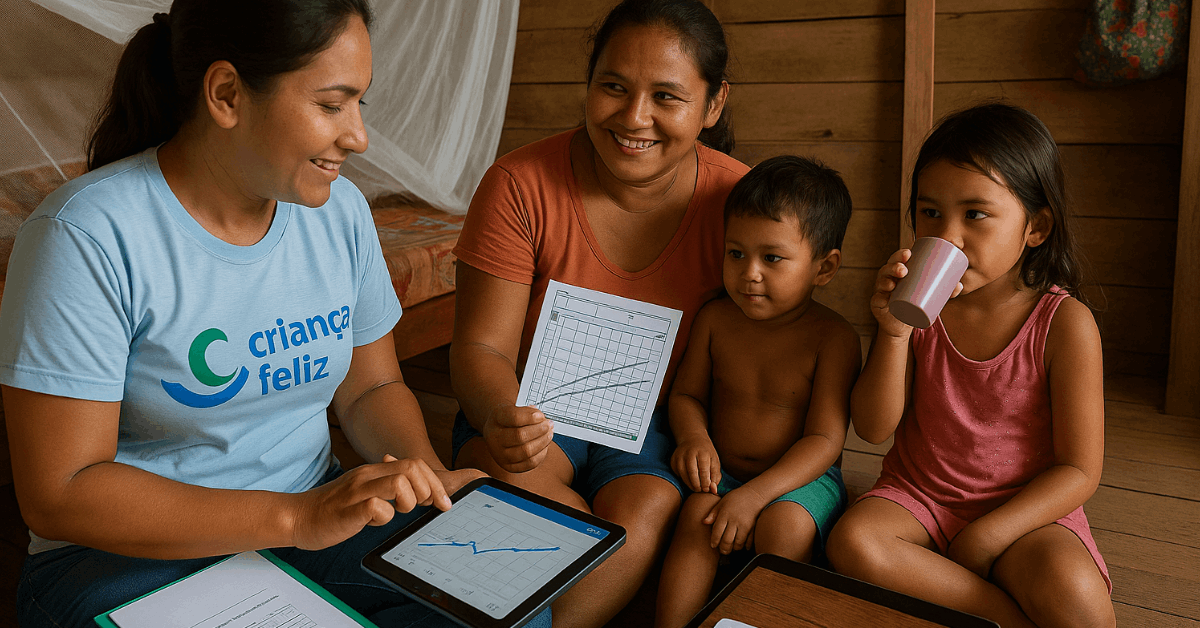
Regular visits guide caregivers on responsive play, nutrition, safety, disability inclusion, and linkages to public services. Strengthening family bonds remains its core objective, supported by the UNICEF/WHO Care for Child Development protocol.
Target Families and Eligibility
Eligibility prioritizes households most at risk of developmental delays.
Families Receiving Bolsa Família
Families enrolled in the Bolsa Família conditional cash-transfer program are automatically prioritized.
These households typically face persistent income insecurity, limited access to quality health care, and a lack of early education opportunities.
By focusing on this group, Criança Feliz reaches children who are at heightened risk of developmental delays and whose caregivers often need structured support and guidance.
Pregnant Individuals and Young Children
Pregnant individuals and families with children under the age of three make up another central group within the program.
The prenatal period and the first 1,000 days of a child’s life represent a crucial window for physical and cognitive development.
Children with disabilities are also included in the program until age six, ensuring that early interventions continue for those who require longer-term developmental support and specialized care.
Households in the National Single Registry
Criança Feliz also selects participants from Brazil’s national Single Registry for Social Programs (Cadastro Único).
This registry compiles household-level data on income, housing, employment, and education, helping municipalities identify families living in poverty or at social risk.
Leveraging this system allows the program to streamline enrollment and maintain fairness and consistency across diverse regions.
Home-Visit Methodology
Clear, structured visits translate global child-development science into daily habits you can adopt immediately.
| Component | Practical Focus for Caregivers | Typical Tools Used |
| Play-based interaction | Build language and motor skills through purpose-driven play sessions lasting at least ten minutes. | Locally produced toys, songs, picture cards |
| Health and nutrition checks | Spot warning signs early and reinforce prenatal care, breastfeeding, micronutrient-rich diets, and immunization schedules. | Growth-monitor charts, referral forms |
| Parental well-being | Manage stress, reduce harsh discipline, and create violence-free homes. | Relaxation breathing scripts, hotline lists |
| Service navigation | Connect families to clinics, disability benefits, and early-learning centers. | Digital case-management app |
Each visit lasts forty-to-sixty minutes, scheduled weekly, fortnightly, or monthly according to family needs.
Intersectoral Coordination Framework
Bridging agencies multiplies impact without inflating budgets. Criança Feliz activates steering committees across federal, state, and municipal levels.
The Ministry of Citizenship sets policy, states train supervisors, and municipalities coordinate frontline activities. Health, education, culture, and human-rights ministries supply technical inputs.
International readers can replicate this layered model to align siloed services under one shared child-outcome agenda.
Workforce and Training Model
A cascading training system protects consistency at national scale.
- National technicians adapt and issue the Care for Child Development curriculum.
- State “multipliers,” all college educated, receive master-class modules and coach municipal supervisors.
- Municipal supervisors train home visitors—minimum high-school graduates—through blended workshops and shadowing sessions.
This three-tier pipeline has prepared more than 19 000 visitors and 3 468 supervisors, demonstrating that quality can scale when responsibilities are clearly partitioned.
Funding and Scale Metrics
Stable financing keeps frontline teams motivated and retention high.
- Federal transfers: about USD 143 million annually from 2017 to 2019.
- Municipal co-financing: approximately USD 20 monthly per enrolled participant.
- Coverage: 4 195 municipalities (75 percent of the national total) by late 2019.
- Reach: more than 50 million cumulative visits, serving over 660 000 families.
Countries evaluating cost feasibility can benchmark these figures against local purchasing power and workforce expenses.
Results and Global Recognition
Large-scale evaluations reveal important wins.
- WISE 2019 Award honored Criança Feliz as an innovative education solution.
- Independent studies reported improved parental knowledge, higher stimulation scores, and modest gains in child language development.
- Municipal case studies noted reduced referrals for neglect and stronger vaccination compliance.
While aggregate effects on developmental indices remain mixed, the program’s ability to penetrate remote Amazonian villages, urban favelas, and refugee corridors underscores its logistical sophistication.
Implementation Challenges
Scaling nationwide exposed pressure points that your own initiative should anticipate.
- Funding gaps occasionally left municipalities short of transport, digital devices, or play materials, lowering visit frequency.
- Political turnover disrupted training cycles, stalling coverage in certain states.
- Monitoring dashboards tracked visit counts yet lacked consistent child-outcome data, hindering rapid course corrections.
Addressing these shortfalls requires diversified funding, civil-service workforce protections, and outcome-based digital monitoring—a universal lesson for early-childhood systems worldwide.
Lessons for International Adaptation
Applying Criança Feliz insights can accelerate early-childhood efforts on any continent.
- Start small but plan for scale. Early pilot sites refined logistics before rapid expansion.
- Anchor to existing cash-transfer registries. Leveraging social-protection databases streamlines enrollment and poverty targeting.
- Train for cultural humility. Visitors in quilombola and Indigenous territories respected caregiving traditions rather than imposing external norms.
- Pair transfers with coaching. Evidence suggests that income plus parenting support yields deeper developmental gains than cash alone.
- Invest in data loops. Simple, mobile-friendly dashboards tracking both process and outcome metrics enable quick pivots.
Practical Actions You Can Use Now
Transform these insights into immediate steps regardless of country size or income level.
- Map every early-childhood stakeholder, health clinics, social-service centers, schools, and build a single coordination forum.
- Draft a basic home-visit protocol drawn from the Care for Child Development framework, adjusting for local language and caregiving customs.
- Train a pilot cohort of paraprofessional visitors using role-play and supervised field practice.
- Integrate enrollment into any existing conditional-cash or food-assistance registry to focus on the poorest families first.
- Set up a lean, cloud-based monitoring tool capturing visit counts, caregiver practices, and child-development milestones.
- Publish semi-annual briefs to keep funders, policymakers, and the public engaged in progress and challenges.
Consistently following these steps positions your jurisdiction to deliver measurable gains in early childhood outcomes.
Conclusion
Criança Feliz illustrates how a structured home-visiting program, powered by intersectoral cooperation and rooted in evidence, can move the needle on child development even in a vast and diverse nation.
Applying its lessons worldwide helps governments and civil-society partners deploy limited resources where they matter most—the critical early years that shape every child’s future.