

Natural hazards, whether wildfires, floods, earthquakes, or hurricanes, can quickly overwhelm local resources.
When losses exceed regional capacity, national governments step in with targeted emergency benefits.
The following guide shows how you can tap into those programs, organize paperwork, and rebound faster.

Why Federal Declarations Matter
A federal or national disaster declaration unlocks funding streams that state, provincial, and tribal authorities cannot activate on their own.
You gain access to cash grants, subsidized loans, tax extensions, and specialized counseling that local agencies rarely provide. Because these resources are time-limited, understanding the menu early boosts your odds of approval.
Core Emergency Benefits at a Glance
Use this snapshot to match each major need with its corresponding relief option.
| Essential Need | Typical Benefit | Coverage Window |
| Temporary income loss | Disaster Unemployment Assistance (DUA) | Up to 26 weeks after declaration |
| Food security | Disaster Supplemental Nutrition (D-SNAP) | First 30 days; extensions possible |
| Shelter | Rental grants, home-repair funds, or mortgage forbearance | Up to 18 months; extensions case-by-case |
| Cash flow for bills | Low-interest loans, utility subsidies, student-loan deferrals | Varies by program—apply within 60 days |
| Community repairs | Public Assistance grants | Reimburse local governments for debris removal and infrastructure fixes |
| Tax relief | Filing and payment extensions | Deadlines shift several months or more |
Individual Assistance: Replacing Day-to-Day Essentials
Upfront clarity on what you can claim saves rework later.
Your Immediate Cash Lifeline
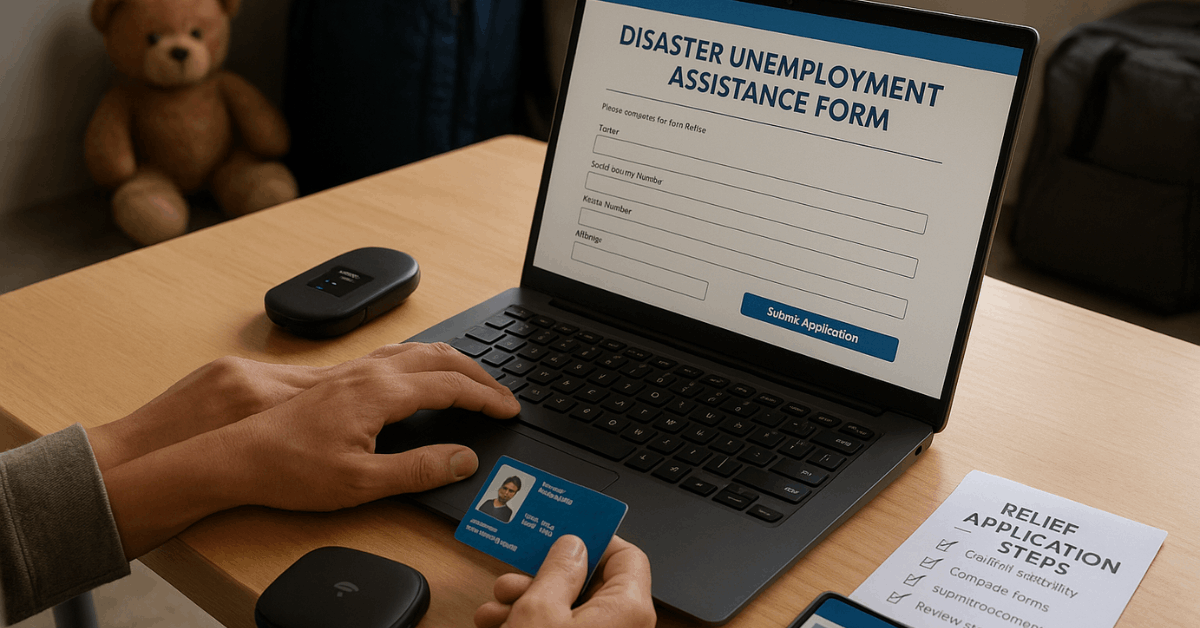
Submit a DUA application through your regional employment office if your workplace shut down because of the disaster and you are not eligible for ordinary unemployment.
Include proof of prior income and a statement explaining how the event caused the job loss.
Food and Water Costs
When a declaration triggers D-SNAP, your household can load a one-time electronic benefit onto an existing or temporary card. Use funds on any staple grocery item; ready-to-eat hot foods are often covered during the first week.
Short-Term Housing
Expect two tracks:
- Rental grants pay for a hotel or an apartment when your home is unsafe.
- Direct repairs cap payouts at standard replacement value; luxury fixtures are excluded.
- If erosion or landslide makes a structure unsafe, you may qualify for relocation support rather than repair funding.
Serious Needs Assistance (SNA)
In several regions, a new USD 750 flat benefit fills the gap between evacuation costs and longer-term aid. You must be displaced and list specific urgent expenses—think fuel, infant formula, prescriptions.
Support for Small Businesses and Non-Profits
Hazard recovery is not just about households. Community vitality depends on local employers reopening quickly.
Eligibility Snapshot
You qualify if annual gross revenue stays under roughly USD 15 million (or the local equivalent) and disaster damage threatens operations. Affordable-housing providers or essential charities may skip the revenue cap.
Funding Mix
Small-Business Administration-style loans deliver affordable capital; interest can be deferred for a year. Equipment-replacement grants cover uninsurable assets up to a USD 3 million ceiling.
Community Development Block Grants flow later, reimbursing reconstruction programs run by city or provincial governments.
Practical Tip
Photograph inventory, machinery, and exterior damage before debris removal. You must prove a direct causal link between the declared calamity and each claim.
Community-Level Assistance: Restoring Public Services
Local governments shoulder hefty costs for emergency response and cleanup. National programs reimburse a high share—often 70 % to 90 %—for:
- Debris removal that threatens public safety
- Emergency protective measures such as temporary berms or firefighting around towns
- Permanent repairs to roads, bridges, parks, and water plants
- Low-interest Community Disaster Loans when tax revenue collapses
Cost-Share Rule
Federal dollars rarely cover 100 %. Your town or province must budget for the remainder, sometimes through bond measures or reallocated capital funds.
Eligibility and Application Steps
A streamlined approach prevents missed deadlines.
- Confirm the declaration scope. Governors or tribal leaders must request federal recognition within 30 days; check that your county, parish, or district is listed.
- Register on the centralized portal (e.g., DisasterAssistance.gov or its national counterpart) within 60 days. Late filings need written justification.
- Gather evidence:
- Pre-disaster pay stubs or tax returns
- Photos, videos, or engineering reports documenting damage
- Receipts for temporary lodging and cleanup supplies
- Track program-specific cut-offs. Food aid often closes after one month; unemployment claims last for 26 weeks.
Limits, Exclusions, and Civil-Rights Guarantees
Federal relief is broad yet not absolute.
- Cost caps mean payouts may not replace every loss. Standard replacement value, not premium upgrades, guides calculations.
- Insurable losses (items a normal policy would cover at an affordable rate) are generally excluded.
- High-risk areas—flood plains, wildfire zones, coastal erosion corridors—must show appropriate mitigation (elevated foundations, fire-resistant roofs) to stay eligible for future events.
- Civil rights law ensures equal access. If language, mobility, or disability barriers exist, agencies must provide accommodations.
Long-Term Mitigation Grants
Once immediate needs settle, mitigation programs fund projects that lower future risk and cut insurance costs.
- Hazard Mitigation Grant Program can finance up to 25 % of combined response and repair costs for upgrades such as floodwalls, backup generators, and community fire breaks.
- Protective natural infrastructure, wetlands expansion, and urban tree buffers qualify if professional studies show risk-reduction benefits equal to concrete solutions.
- Relocating repeatedly damaged homes may be covered, but the land must be restricted from future development to prevent recreating the risk.
Grant applications require a cost-benefit analysis demonstrating that lifetime savings exceed project expenses.
Common Pitfalls and How to Avoid Them
Avoid these stumbling blocks to keep money flowing:
- Missing the 60-day registration deadline
- Submitting estimates instead of itemized receipts when the program demands actual costs
- Overlooking insurance claim letters, leading to duplicate-benefit clawbacks
- Ignoring local permit rules during repairs, which can invalidate grants
- Failing to include a disaster-specific explanation on unemployment forms
Quick-Reference Checklist for Applicants
Keep this list on your phone or printed in your go-bag.
- Verify the disaster declaration covers your location.
- Create or update your online disaster-assistance profile.
- Photograph and video all damage before cleanup.
- Keep lodging and meal receipts in a single envelope or cloud folder.
- File insurance claims immediately, even if coverage seems doubtful.
- Submit DUA or local unemployment paperwork within the stated window.
- Ask case managers about Serious Needs Assistance or similar rapid-cash programs.
- Review mitigation options (elevating utilities, adding backflow valves) before rebuilding.
- Note every grant and loan deadline in your calendar with reminders one week prior.
Conclusion
By learning how federal benefits operate and gathering evidence early, you position yourself and your community to secure essential support when a calamity becomes nationally recognized.
The programs outlined above may differ in name from one country to another, yet their core objective remains universal: safeguarding lives, stabilizing incomes, and funding resilient rebuilding so that the next storm, quake, or fire leaves far less harm.