
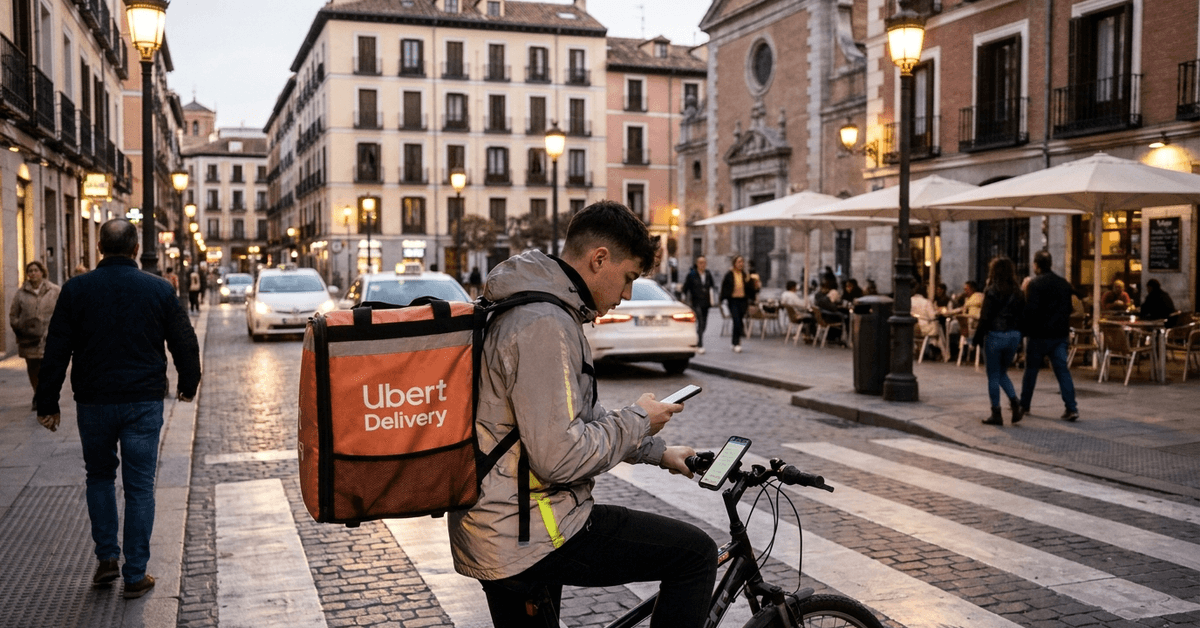
A food delivery job in Spain used to mean downloading Glovo, registering as autónomo, and earning €3,000 to €4,000 a month if you hustled 10 to 12 hours daily across multiple apps. That model is almost gone.
Spain's Ley Rider (Ley 12/2021) forced platforms to hire riders as salaried employees starting August 2021. Five years later, the shift has finally caught up with every major app in the country.
If you're a student, recent immigrant, or newcomer planning to deliver food in Spain this year, the job you'll get looks nothing like the one older guides describe. This piece is for you.
How Spain's Ley Rider Reshaped Food Delivery Work
Spain's Ley 12/2021, commonly called the Ley Rider, created a legal presumption that delivery riders working through digital platforms are employees, not independent contractors.
The law took effect in August 2021. But enforcement moved slowly. Platforms stalled, appealed, and kept using autónomo riders for years.
Glovo's €205 Million Lesson
Glovo resisted the longest. Spain's labor inspectors hit the company with fines totaling €205.3 million for maintaining tens of thousands of false autónomos. That includes penalties across Barcelona, Valencia, and Madrid between 2022 and 2024.
The pressure finally broke Glovo's model. The company regularized roughly 14,000 riders with labor contracts by mid-2025.
Uber Eats and the Subcontractor Pivot
Uber Eats announced in January 2026 that it would stop collaborating with self-employed delivery drivers entirely. The change affects over 7,000 riders.
Instead of hiring directly, Uber Eats shifted to subcontracted fleets staffed by logistics companies. So you won't sign up with Uber Eats as an individual anymore. You'll apply to a logistics firm that supplies riders to the platform.
Where Deliveroo and Just Eat Stand
Deliveroo left Spain back in 2021, citing unprofitable conditions under the new labor rules. Just Eat operated with hired employees from the start, so the Ley Rider barely touched its operations.
What Food Delivery Drivers Earn in Spain Now
Indeed Spain's August 2026 salary data puts the average repartidor salary at roughly €1,584 per month in Catalonia, close to the national average.
That number tracks with Spain's delivery sector collective agreement, which sets the baseline at around €1,800 brutos (gross) monthly for salaried riders. After social security deductions, take-home pay drops closer to €1,400 to €1,500.
The Old Autónomo Math vs. The New Employee Math
I think the popular advice to "go autónomo for maximum flexibility" stopped making sense after Glovo's 2025 regularization wiped out multi-app earnings.
Riders who worked as autónomos before the Ley Rider enforcement paid the maximum RETA quota of about €380 per month.
But they could work for:
- Glovo,
- Uber Eats,
- Amazon Flex, and
- Deliveroo simultaneously.
Splitting shifts across four apps pushed monthly income to €3,000 or €4,000.
The only platforms still accepting individual autónomos in 2026 are Amazon Flex and some parcel delivery services. One platform alone rarely generates €3,000 a month.
Who Can Apply for Food Delivery Jobs in Spain
The requirements depend on whether you're joining as an employee through a subcontractor or registering independently for the few remaining autónomo-friendly platforms.
Every applicant needs these basics:
- Minimum age of 18
- A valid DNI (Spanish national ID) or NIE (Número de Identificación de Extranjero) with work authorization
- A smartphone capable of running the delivery app
- Basic Spanish. English alone won't cut it outside tourist zones
If you're delivering by motorbike or car, add these:
- A valid EU driving license
- Vehicle registration, insurance, and a current ITV (inspección técnica de vehículos) certificate
- Personal accident insurance (most platforms require proof)
Bicycle riders skip the license and ITV but still need the ID and work permit.
Non-EU Citizens and Visa Limits
A student visa (estancia por estudios) allows up to 20 hours per week of paid work. That can work for part-time delivery shifts, but full-time hours require a work permit or residency that allows unrestricted employment. The NIE alone is not a work permit.
How to Get Hired Through a Subcontractor Fleet
Since Glovo, Uber Eats, and Just Eat now hire through employment or subcontracting arrangements, the application process runs through the logistics company, not the app itself.
| Platform | Employment Model (2026) | How to Apply |
|---|---|---|
| Glovo | Direct employees after regularization | Through Glovo's careers page or subcontractor listings |
| Uber Eats | Subcontracted logistics fleets | Apply to logistics firms like Stuart or local fleet operators |
| Just Eat | Direct employees since launch | Job board listings on Just Eat or Indeed Spain |
Most subcontractor roles post on Indeed Spain or InfoJobs. Search for "repartidor" plus your city name.
The hiring process usually follows three steps: online application with document upload, vehicle or equipment verification, and a short onboarding session covering app use and safety protocols.
Registering as Autónomo: Still Worth It?
The autónomo path still exists for Amazon Flex, independent parcel delivery, and a handful of smaller platforms. Registration goes through two agencies.
First, file Modelo 036 or 037 with Hacienda (Spain's tax agency) under economic activity code IAE 849 for courier and delivery services.
Second, register with the RETA (Régimen Especial de Trabajadores Autónomos) through Spain's Social Security system. New registrants qualify for the tarifa plana of €80 per month for the first 12 months.
After that, contributions jump to roughly €230 to €500 monthly based on real income under the 2023 cotización por ingresos reales system.
Tax Obligations You Can't Skip
Autónomo riders must file quarterly VAT returns (IVA at 21% for Spanish platforms) and annual income tax declarations (IRPF).
Deductible expenses include your bicycle or motorbike (prorated), helmet, repair costs, smartphone (50%), thermal delivery bag, and the RETA quota itself.
Keep every receipt. Spain's tax agency cross-references platform payment data.
The Small-City Problem Nobody Talks About
Glovo's May 2026 ERE (expediente de regulación de empleo) laid off 436 riders across 60 cities where delivery volume couldn't cover the higher labor costs of salaried workers.
This is the part that gets missed in "food delivery jobs in Spain" guides. The Ley Rider protected workers in Madrid, Barcelona, and Valencia. But in smaller cities, the math broke. Platforms pulled out rather than operate at a loss.
If you're looking for delivery work outside Spain's top 10 metro areas, check whether your city still has active platform operations before investing in equipment or registration fees.
A thermal bag and a monthly autónomo quota cost real money when there are no orders to fill.
When to Work for Maximum Orders
Delivery demand in Spain follows predictable meal rhythms. The busiest windows are:
- Lunch: 13:00 to 15:00 (Spain eats late)
- Dinner: 20:00 to 22:30
- Friday and Saturday evenings
- Rainy days and holidays when restaurants see order spikes
Weekday mornings are dead. If you're splitting delivery work with classes or another job, lunch and dinner slots give you the best order density per hour.
Questions People Ask About Food Delivery Jobs in Spain
A few things come up repeatedly for people researching this work in 2026.
- Q: Can I work for Glovo as an autónomo in 2026?
Glovo completed its rider regularization in 2025. New riders join as employees or through affiliated subcontractors. The individual autónomo sign-up that older guides describe no longer applies to Glovo. - Q: Do I need to speak Spanish to deliver food in Spain?
Enough to handle brief customer interactions and read app instructions. App interfaces are in Spanish. Some platforms offer English settings, but restaurant staff and customers communicate in Spanish or regional languages. - Q: How long does the autónomo registration take?
Filing Modelo 036 with Hacienda and registering with RETA can take a few days if your documents are ready. The NIE itself takes longer for non-EU applicants, sometimes several weeks depending on your local extranjería office. - Q: Is the EU Platform Work Directive going to change things again?
EU Directive 2024/2831 requires all member states to transpose platform labor rules by December 2, 2026. Spain already has the Ley Rider, so adjustments may be minor. But the directive covers all platform work, not just delivery, so expect broader changes to VTC and freelance apps. - Q: What happens if I get caught working as a false autónomo?
The platform faces the fines, not you. But you lose the job when the company restructures. Riders who were false autónomos through Glovo had their employment status retroactively recognized, which meant back-payment of social security contributions by the company.
Conclusion
Spain's food delivery market in 2026 runs on employment contracts, subcontractor fleets, and shrinking autónomo options. The gig as your parents' internet articles described it is a different animal now.
Smaller cities lost platform coverage after the Ley Rider raised labor costs beyond profitability. Registering as autónomo still works for Amazon Flex and parcel delivery, but the multi-app hustle era ended.