
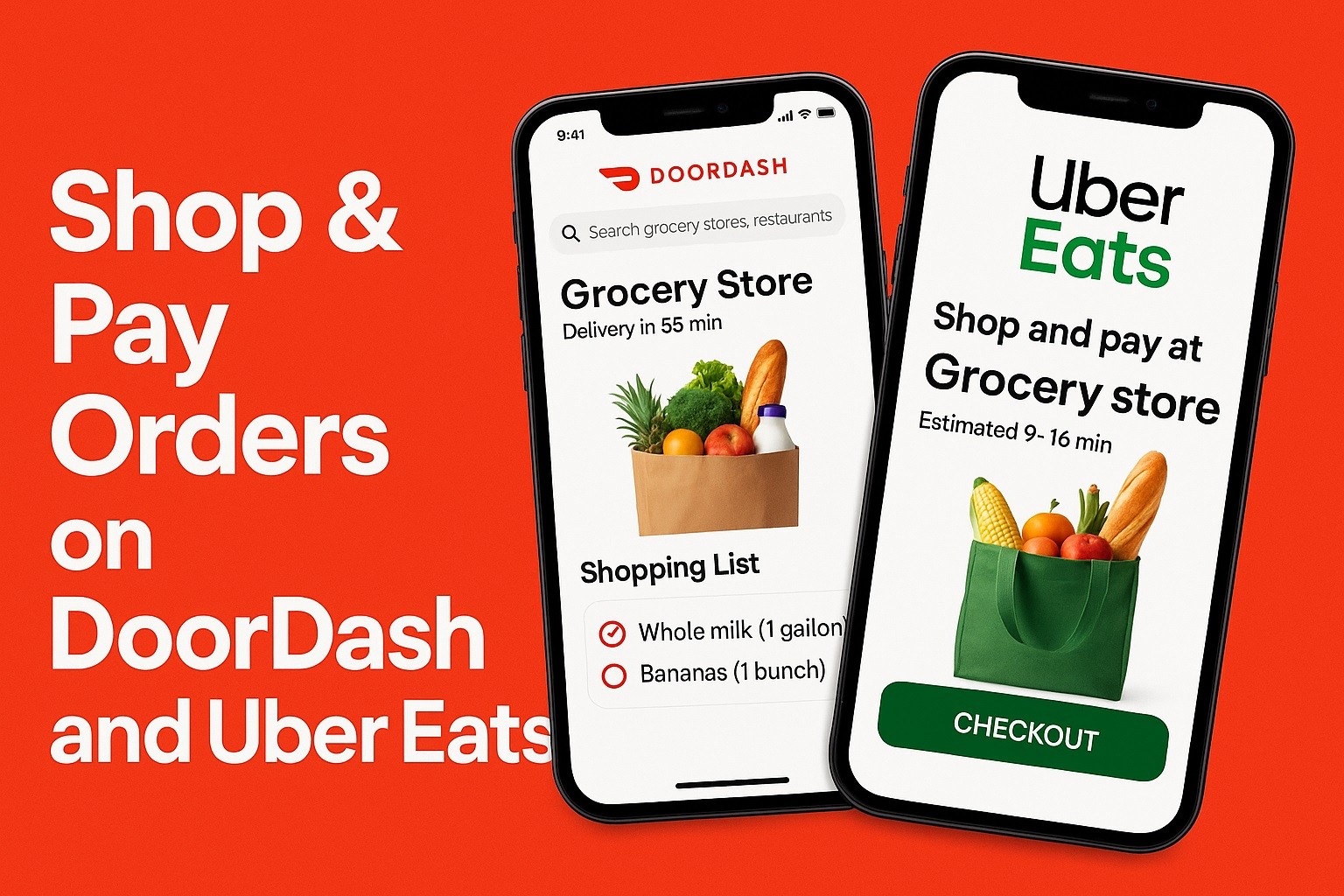
“Shop & Pay” (also called Shop & Deliver) turns delivery drivers into in-store shoppers who buy a customer’s list and then deliver it.
The work can pay well—but only if you set up your tools correctly, follow compliance rules, and choose the right orders.
This shop and pay orders strategy guide explains all details as of August 15, 2025.
How Shop And Pay Orders Strategy Works On Each Platform
DoorDash and Uber Eats have their own way of using it.
DoorDash (Shop & Deliver)
After accepting a Shop & Deliver offer, you shop the list, pay with DoorDash’s Red Card, and deliver.
DoorDash provides item photos, location hints, and suggested substitutions inside the Dasher app to speed up the shop.
The Red Card can be digital (Apple/Google wallet) or physical; the card is pre-funded automatically at checkout for eligible orders.
Uber Eats (Shop & Pay / Shop & Deliver)
You’ll use Uber’s Plus Card (physical and/or digital) to check out.
Uber’s shopper flow surfaces aisle information and replacement suggestions, and allows you to message the customer to confirm substitutes in real-time.
Required Tools And Setup
A good shop and pay orders strategy requires the right tools.
DoorDash—Red Card basics
You can dash without a Red Card, but you’ll only see orders that don’t require in-store payment.
To accept Shop & Deliver consistently, activate a digital Red Card (wallet) and/or request a physical card as backup.
The Red Card is a prepaid card funded by DoorDash at checkout—not linked to your bank account. If a merchant isn’t set up for contactless, use the physical card.
Uber Eats—Plus Card options
Uber supports a physical Plus Card and a Digital Plus Card, which you add to Apple Wallet/Google Wallet from inside the Driver app.
Eligibility is by invitation/availability in your market. If the Plus Card fails and you choose to pay with your card, Uber will reimburse you with a receipt.
Uber typically requires a photo of the itemized receipt after checkout on Shop & Deliver trips; the prompt appears in the Driver app.
How You Get Paid
On both apps, longer shops, heavier carts, or complicated substitutions can increase the time component.
So, always weigh the total minutes and miles against the offer amount you see upfront.
DoorDash pay
Earnings combine Base Pay (typically $2–$10+ per offer, based on estimated time, distance, and desirability) plus tips and promos like Peak Pay.
Shop & Deliver can pay more per order on average than restaurant-only runs, though results vary by market and time.
Uber Eats pay
Uber calculates delivery fares primarily by estimated time and distance, sometimes with a trip supplement; tips stack on top.
Uber shows upfront estimated earnings before you accept, reflecting the base and any supplement (tips are separate).
Compliance You Can’t Ignore
DoorDash uses an enhanced ID process: at drop-off, Dashers must complete a digital scan plus a physical check and confirm the recipient isn’t intoxicated.
If the delivery can’t be completed (e.g., underage, no valid ID), the app instructs you to return the alcohol to the store.
Uber’s policy is to refuse delivery if the recipient is underage or intoxicated, and to verify ID in person where alcohol delivery is available.
Always bring your government ID when shopping for alcohol; some merchants will card the shopper at checkout.
Smart Order Selection
Scan the cart, not just the pay. Favor orders with clear aisles/brands, lower item counts, and stores you know well.
Add the shopping time to the drive time. A 3-mile delivery after a 35-minute shop isn’t the same as a 3-mile handoff from a restaurant.
Use the replacement prompts early and message the customer if an exact match is unlikely.
Know your building mix. Elevators, secure entries, and campuses eat time. Consider drop-off complexity when weighing the offer.
In-store Execution That Saves Minutes
This reduces back-and-forth later and prevents checkout surprises.
- Shop by aisle path: Use the app’s aisle/location hints and item photos/notes to create a single lap through the store.
- Handle perishables last: Grab frozen and refrigerated items at the end and use an insulated bag to protect quality in transit.
- Document the checkout: Always keep/photograph the receipt (mandatory on some Uber trips; useful for DoorDash reimbursements and support). Upload when prompted.
- Be ready to pivot on payment: If contactless fails, switch to your physical Red Card (DoorDash). If the program card fails and support approves, use your card, save the receipt, and request reimbursement (both apps support reimbursement flows).
Avoid The Common Pitfalls
Follow the scan + physical check or refusal rules exactly; if the ID fails, return the order per app prompts.
No receipt often means no reimbursement. Make the photo a habit, even when the app doesn’t explicitly ask.
Remember that Uber’s upfront estimate may exclude tips in some markets, and DoorDash’s base can be as low as $2.
Don’t sink 40 minutes into a small cart unless the numbers work.
Quick Compare: Where They Differ
DoorDash emphasizes a physical Red Card backup for non-contactless merchants. Uber’s Digital Plus Card is added from the Driver app’s Plus Card section.
A receipt photo is typically required on Uber; on DoorDash, keep receipts for reimbursements and in case support requests them.
DoorDash’s dual ID scan and paid returns are common; Uber requires refusal to underage/intoxicated recipients and continues to expand ID tech.
Advanced Strategies To Raise Your Hourly
Specialize in two or three grocery stores. Familiarity with aisles, private-label equivalents, and common substitutions can cut 5–10 minutes per shop.
Use a notes app or spreadsheet to log start time, end time, miles, and payout. Decline orders that routinely drop you below your target hourly.
Keep two insulated bags—one for frozen/cold, one for hot—and a small thermal divider. Fewer complaints mean fewer support contacts.
Build a routine: snap the receipt at the register, place it in a labeled envelope, then upload as soon as the app prompts.
Conclusion
Treat every shop and pay orders strategy as a small project: (1) estimate, (2) communicate, (3) control checkout, (4) document, (5) deliver cleanly.
Choose orders where the minutes and miles justify the pay, use the in-app location and substitution tools to compress shop time, and protect yourself.
With the right setup—a digital wallet card, a physical backup, and a receipt routine—Shop & Pay can be a reliable, higher-earning lane in your delivery mix.