

A food delivery driver working six days a week in Bogotá takes home roughly COP 2.3 million per month. That sounds decent until you subtract fuel, phone data, tire wear, and SOAT insurance.
Colombia's Law 2466, approved in June 2025, was supposed to clarify platform workers' rights. As of mid-2026, the regulation is still stuck in committee limbo between the Ministry of Labor and the delivery companies.
This article is for anyone in Colombia thinking about signing up as a courier on Rappi, Domicilios.com, or iFood. Specifically, the person who needs real numbers and real legal context, not a cheerful "be your own boss" pitch.
How Much Do Food Delivery Drivers Earn in Colombia?
Rappi couriers earn between COP 70,000 and COP 100,000 per day, depending on the day of the week and the city. Weekdays land closer to COP 70,000 to COP 80,000. Weekends push toward COP 90,000 to COP 100,000.
Those figures come from Rappi's own estimates. La República reported these same numbers in a breakdown of rappitendero earnings.
The Expense Problem Nobody Quantifies
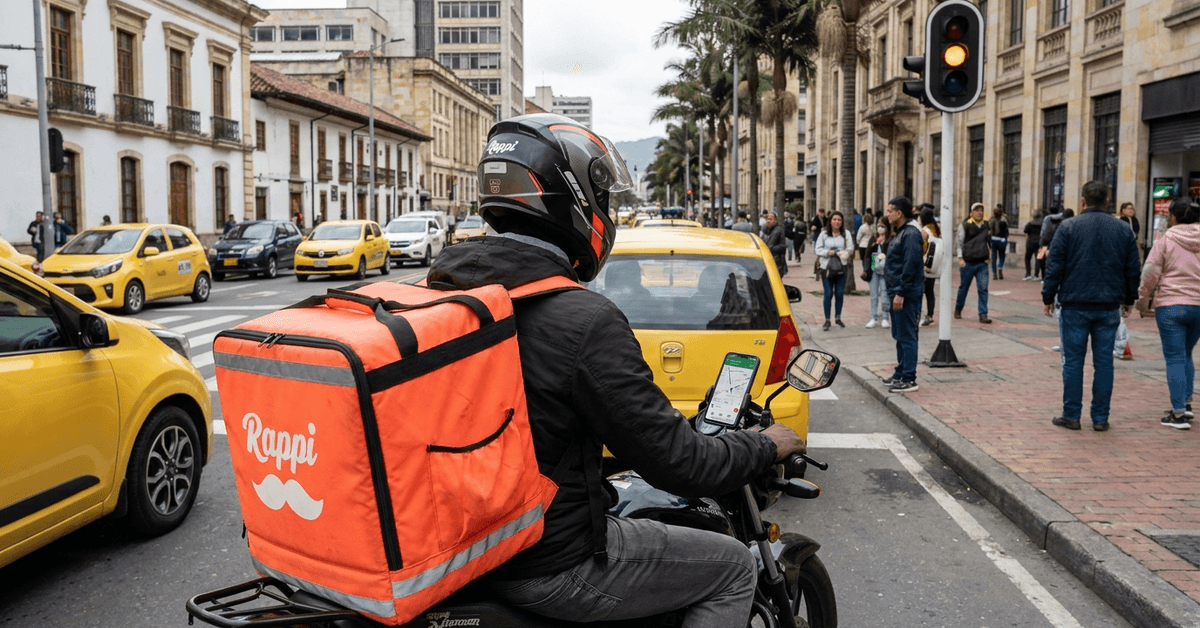
Rappi estimated its couriers earn an average of COP 11,000 per hour (about $2.65 USD). But that's gross pay. Critics pointed out that gas, motorcycle maintenance, and data plans can eat roughly half of daily earnings.
I think the standard advice to "just track your peak hours" misses the bigger problem.
If a Rappi courier in Bogotá spends COP 35,000 to COP 40,000 daily on fuel and maintenance alone, the effective hourly rate drops well below Colombia's 2026 minimum wage.
Tracking hours means nothing if you're not tracking expenses against those hours.
ERI Salary Data vs. Platform Reality
ERI Economic Research Institute pegs the average delivery driver salary in Colombia at COP 44.1 million annually. That's roughly COP 3.6 million per month.
The gap between ERI's figure and Rappi's COP 2.3 million estimate is striking. ERI's number likely includes salaried drivers at logistics companies, not just gig couriers. Platform-based earnings and salaried delivery pay are different categories.
What Platforms Are Hiring Delivery Drivers in Colombia?
Three platforms dominate the Colombian market. Each has different onboarding speed, coverage, and payout schedules.
- Rappi holds over 50% of Colombia's delivery market, connecting more than 30,000 businesses with about 3 million active users. It operates in almost every major Colombian city and runs the most thorough vetting process of the three.
- Domicilios.com focuses heavily on urban centers and has a simpler onboarding flow. It is owned by Delivery Hero and has strong name recognition in cities like Medellín and Cali.
- iFood is the newest competitor gaining ground. It offers app-based driver support and has been expanding its city coverage through 2025 and 2026.
Can you work for more than one platform at the same time? Technically, most contracts don't explicitly ban it. But some platforms discourage simultaneous use during active shifts, and juggling two apps at once can tank your ratings on both.
Requirements to Sign Up as a Delivery Driver
The signup process is mostly digital, but missing one document can stall your approval for weeks. Every platform asks for a similar set of documents, with minor differences.
You need to be at least 18 years old. Some platforms set a higher minimum age for motorcycle or car couriers.
Core documents include:
- A valid cédula de ciudadanía or cédula de extranjería (foreigners need a valid visa or permiso with work authorization)
- SOAT (Seguro Obligatorio de Accidentes de Tránsito) for any motorized vehicle
- Vehicle ownership proof or a leasing agreement
- A bank account in your name for receiving payouts (some platforms accept digital wallets like Nequi or Daviplata)
- A smartphone with mobile data and GPS capability
The Criminal Background Check Catch
Some platforms, especially in Bogotá and Medellín, ask for a certificate of antecedentes judiciales. This is a criminal background check issued through the Policía Nacional's online portal.
The document itself is free and takes about 10 minutes to generate online. But if your name matches someone else's record (common with popular Colombian surnames), the clearance process can stretch into weeks. Upload it early.
Vehicle Types and What Each Costs You
Your vehicle choice shapes your earning potential and your expense burden:
| Vehicle | Upfront Cost | Daily Operating Cost | Best For |
|---|---|---|---|
| Motorcycle | COP 5M–15M (used) | COP 25,000–40,000 (fuel + wear) | Speed, most orders |
| Bicycle | COP 500K–2M | Near zero | Dense urban zones, low capital |
| Car | COP 20M+ (used) | COP 40,000–60,000 | Bad weather, large orders |
| Walking | None | None | Tight downtown radiuses |
Motorcycles dominate. They're the fastest option and get access to the most orders. But the daily operating cost means your take-home shrinks faster than bicycle couriers realize.
Law 2466 and What It Means for Platform Couriers
Colombia's Law 2466, approved in June 2025, is the country's first attempt at regulating platform-based work. It amends the Colombian Labor Code and addresses working hours, social security, and the legal status of gig workers.
The law reduces the standard workweek to 42 hours as of July 15, 2026. It also requires platforms to contribute 60% of each courier's health and pension payments, leaving the remaining 40% to the worker.
The Regulation Is Still Incomplete
As of May 2026, a WageIndicator report confirmed that Law 2466 is still awaiting full regulation. A technical working group involving the Ministry of Labor, the Ministry of ICT, platform companies, and the union UNIDAPP has been meeting.
But the central disagreement over how to define "employment" versus "independent contractor" status remains unresolved.
Jhonniell Colina, president of UNIDAPP, told WageIndicator that companies resist defining the boundary between employment and contractor status.
The February 2026 Rappi Agreement
A separate development happened in February 2026. UNIDAPP reached a direct agreement with Rappi following a court order that instructed the company to stop blocking driver accounts without due process.
The agreement included a minimum payment of COP 3,050 per completed delivery. That's small per trip, but it set a floor where none existed before. If you're signing up for Rappi today, this minimum applies to your account.
Tax and Insurance: Two Things New Couriers Skip
Most couriers in Colombia work as independent contractors. That classification means labor protections differ from traditional employment, and it also means you handle your own tax filings.
DIAN Tax Obligations
Income earned through platforms must be declared to DIAN (Dirección de Impuestos y Aduanas Nacionales). Many new couriers ignore this until their annual income passes the non-taxable threshold.
The threshold changes yearly. For 2026, check DIAN's published tables directly. Falling behind on declarations can trigger penalties and interest, and DIAN has been tightening enforcement on gig income.
Insurance Beyond SOAT
SOAT covers basic accident liability for your vehicle. Some platforms offer supplementary health coverage for work-related incidents, but the details are buried in user agreements.
Read the fine print. Platform-provided coverage often excludes injuries sustained when the app is off or between deliveries. A private ARL (Administradora de Riesgos Laborales) policy may fill that gap, though it adds another monthly cost.
The Step-by-Step Signup Process
Applying takes 15 to 30 minutes of form-filling. Approval takes 3 to 10 business days depending on the platform and your document quality.
- Download the courier app for Rappi, Domicilios.com, or iFood
- Create a profile and upload all required documents (clear, well-lit photos speed up approval)
- Complete the onboarding module: a short online session covering safety rules and delivery procedures
- Wait for account activation (you'll get push notifications when approved)
- Start accepting orders and choosing your own shift windows
One common mistake: uploading blurry SOAT scans. Platforms reject unclear documents silently, and you won't always get a specific rejection reason. Re-upload crisp images preemptively.
Questions People Ask About Food Delivery Jobs in Colombia
A few things that come up repeatedly for new and prospective couriers.
- Q: Can foreigners work as delivery drivers in Colombia?
Yes, but you need a valid cédula de extranjería or a visa/permiso that authorizes work. Tourist visas don't qualify. The document upload step will flag missing work authorization, and approval won't move forward without it. - Q: Do Rappi couriers get benefits like health insurance or paid leave?
Not automatically. Law 2466 requires platform contributions toward health and pension once fully regulated. Until that regulation is finalized, most couriers self-fund their social security through independent contributor payments at their local EPS. - Q: What's the best city in Colombia for delivery driver earnings?
Bogotá has the highest order volume, but also the highest operating costs (fuel, traffic, tolls). Medellín and Cali offer strong demand with slightly lower expenses. Smaller cities have growing demand but fewer daily orders. - Q: How many hours per week do most couriers work?
Full-time couriers typically work 40 to 50 hours across six days. Part-time couriers pull 15 to 25 hours, usually during peak lunch and dinner windows. Earnings scale roughly linearly, but peak-hour strategy matters more than total hours logged. - Q: Can I use a bicycle and still make decent money?
Bicycle couriers work best in dense zones like Bogotá's Chapinero or Medellín's El Poblado, where distances between restaurants and customers stay short. Earnings are lower per trip, but zero fuel costs offset part of the difference.
Conclusion
Food delivery work in Colombia pays real money, but only if you subtract real costs first. Law 2466 will reshape courier rights once its regulation clears, so the rules may shift again soon.
The platforms are profitable and growing. Whether the couriers share in that growth depends on what happens next at the Ministry of Labor.