

Laid off, burned out, or just tired of gig work? A food processing plant job might be the steadiest paycheck nobody around you is talking about.
The food processing industry hires across all 50 states, and the barrier to entry is shockingly low. A high school diploma and a pair of steel-toed boots can land you on a production line within weeks.
But steady pay and low requirements don't tell the full story. The shifts are long, the work is physical, and the difference between a good plant and a miserable one comes down to details that job listings never mention.
So if you're seriously weighing food processing plant jobs as your next move, this breakdown covers pay, roles, locations, and the stuff career blogs conveniently leave out.
What Do Food Processing Plant Workers Do All Day?
The phrase "food processing" covers a massive range of daily work. A plant that packages frozen vegetables runs nothing like a facility slaughtering poultry. The hours, pace, and physical toll differ wildly depending on what product rolls off the line.
That said, a few role categories show up at nearly every facility in the country.
Production Line Worker
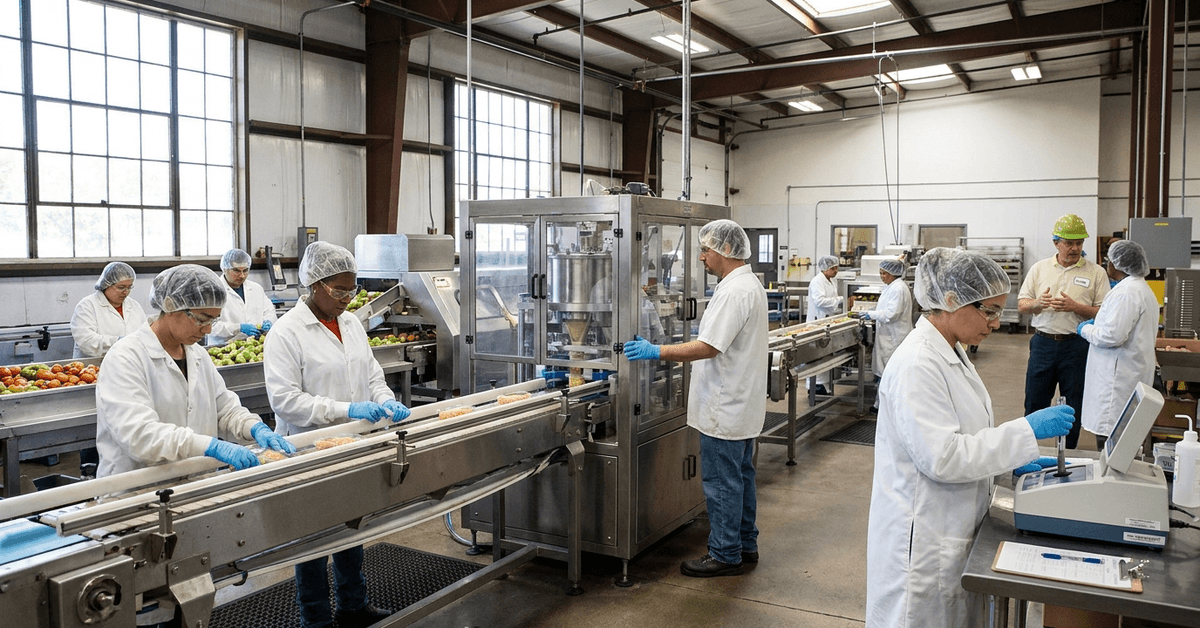
The most common entry point. Production line workers sort, assemble, and package food items on a moving line.
The tasks change based on the product: peeling shrimp looks different from boxing cereal. Standing for 8 to 10 hours is standard. Repetitive motion is constant.
I would pick this role only as a short-term starting point, because the $13 to $17 per hour range reported by the Bureau of Labor Statistics leaves very little room after taxes and commuting costs.
Machine Operator
Machine operators handle the automated equipment that keeps production moving. Setting up, calibrating, and troubleshooting machines are the daily tasks. Prior mechanical experience helps, but many plants train new hires on site.
The pay bump matters here. Machine operators typically earn $15 to $20 per hour, and the skill set transfers well to other manufacturing sectors if you leave.
Quality Assurance and Sanitation Roles
Quality assurance technicians inspect samples, run basic lab tests, and verify that each batch meets food safety standards. Attention to detail and comfort with documentation are the two traits that matter.
Sanitation workers handle the cleaning and decontamination of equipment between shifts. The work is physically demanding and often happens during off-peak hours, but pay ranges sit between $13 and $18 per hour.
Maintenance Technician: The Role Worth Targeting
Maintenance technicians are the highest-paid hourly workers on most plant floors. When a conveyor belt jams or a refrigeration unit fails, production stops until this person fixes it.
Hourly wages range from $18 to $30, and overtime pushes that number higher during peak seasons.
I think skipping entry-level production work and getting a maintenance certification first is smarter than the "start at the bottom" advice that every career site repeats.
The Bureau of Labor Statistics lists a pay gap of roughly $5 to $13 per hour between a starting production worker and a starting maintenance tech.
Spending 3 to 6 months on a technical certificate before applying can mean earning $10,000 to $15,000 more in your first year alone.
Food Processing Plant Jobs Salary Comparison
Knowing the roles is half the picture. The other half is understanding how much each one pays and where the real earning power sits. The table below breaks it down based on 2024 BLS data and common industry ranges.
| Role | Hourly Wage (USD) | Overtime Likelihood | Typical Entry Requirement |
|---|---|---|---|
| Production Worker | $13 - $17 | High | High school diploma |
| Machine Operator | $15 - $20 | Moderate | On-the-job training |
| QA Technician | $16 - $22 | Low | Detail orientation, basic lab skills |
| Sanitation Worker | $13 - $18 | High | Physical fitness |
| Maintenance Technician | $18 - $30 | High | Technical certification preferred |
| Supervisor | $20 - $35 | Moderate | Internal promotion or prior experience |
The takeaway: a production worker earning $14/hr who moves into a maintenance tech role at $22/hr gains roughly $16,640 per year on a 40-hour week, and that math gets even better once overtime kicks in.
Night Shift and Overtime: The Hidden Pay Multiplier
Plants that operate 24 hours a day often pay a shift differential for nights and weekends.
That premium typically adds $1 to $3 per hour on top of base pay. During holiday production surges (Thanksgiving and Christmas are the busiest), overtime becomes almost mandatory.
A production worker at $15/hr base who takes a night shift differential of $2 and works 10 hours of weekly overtime during peak months can earn over $40,000 annually.
That math rarely appears in standard job descriptions, but it changes the calculation for anyone comparing this work to retail or warehouse alternatives.
Where Are Food Processing Plant Jobs Hiring in 2026?
Geography matters more than people realize for this industry. A job seeker in downtown Manhattan won't find many options, but someone near agricultural hubs will see hundreds of open listings.
Top States for Food Processing Employment
The states with the highest concentration of food processing plant jobs cluster around agriculture and livestock:
- Iowa and Illinois: Corn, soy, and pork processing plants dominate, with employers like Tyson Foods and JBS running large facilities
- Texas and Arkansas: Poultry and beef processing create thousands of roles, particularly in smaller cities and rural areas
- Georgia and North Carolina: Poultry again, plus large-scale produce packaging operations
How to Search for Open Positions
The fastest path to an interview involves three channels:
- Company career pages directly: Tyson Foods, Kraft Heinz, ConAgra, and JBS all post openings on their own sites
- Job boards like Indeed and Glassdoor, filtered by "food processing plant jobs near me"
- Local staffing agencies, which fill a large percentage of seasonal and temporary positions
One thing job seekers overlook: many plants hold open walk-in hiring events, especially during peak production seasons. Showing up in person with a resume and ID can skip the online application queue entirely.
Union vs. Non-Union Food Processing Plants
The union question is the single factor that most career articles gloss over, and it changes everything about compensation and working conditions.
What a Union Contract Adds
Unionized plants, often represented by UFCW (United Food and Commercial Workers), typically offer a benefits package that includes health insurance, paid vacation, and retirement contributions.
Non-union plants may offer some of these, but the consistency and enforcement differ.
The pay itself can also differ. Union contracts often lock in scheduled raises, which removes the ambiguity of performance-based increases that some non-union employers promise but don't always deliver.
The Trade-Off Nobody Mentions
Union dues eat into take-home pay. That cost varies by local chapter but typically runs $20 to $50 per month.
For a worker earning $15/hr, that's a noticeable slice. But the trade-off usually nets positive once you factor in guaranteed raises, grievance protections, and better health coverage.
Asking about union status during the interview process is completely fair and tells you more about your future at that plant than almost any other single question.
Legal Requirements and Safety Training
Federal agencies like OSHA and the USDA regulate plant operations. Every new hire goes through safety training covering emergency procedures, hygiene protocols, and equipment handling.
Steel-toed footwear, clean uniforms, and sometimes protective eyewear or hairnets are standard.
Certifications That Open Doors
Certain roles require or strongly prefer certifications:
- HACCP certification (Hazard Analysis and Critical Control Point): required for most quality assurance positions
- Forklift operator license: needed for warehouse and loading dock roles
- Chemical sanitation training: required at plants using industrial cleaning agents
These certifications are often employer-sponsored, so asking about training programs during interviews is a smart move. Some plants also offer tuition reimbursement for further education related to food technology or logistics.
Legal eligibility to work in the U.S. is mandatory. Background checks and drug screenings are standard during the hiring process. Some facilities hire through temporary visa programs, though entry-level positions are usually filled locally.
Moving Up: Career Growth at Food Processing Plants
Advancement follows a predictable pattern at most plants. Reliable attendance, willingness to cross-train on different lines, and expressing interest in open supervisor or technician roles are the three things that get people promoted.
Larger companies like Tyson and ConAgra have internal training pipelines. Completing these programs can move a production worker into a supervisory role within 12 to 24 months.
The career ceiling for someone willing to pursue a food science or industrial management degree (often subsidized by the employer) extends all the way to plant manager. That's a salaried position well above $70,000 annually at mid-size facilities.
Questions People Ask About Food Processing Plant Jobs
Q: Do food processing plants hire people with no experience?
Absolutely. Production line and sanitation roles at plants like Tyson and JBS regularly hire workers with zero prior experience. On-the-job training usually lasts one to two weeks before full shifts begin.
Q: Are food processing plant jobs safe?
OSHA regulates these facilities, and safety training is mandatory for all new hires. Injury rates have dropped in recent years, but cold environments, sharp equipment, and repetitive motion still present risks. Asking about a plant's safety record during interviews is reasonable.
Q: Can food processing plant workers make $50,000 a year?
A maintenance technician or machine operator working regular overtime and night shifts can clear $50,000 or more annually. Entry-level production workers would need consistent overtime and shift differentials to reach that number.
Q: What is the worst part of working at a food processing plant?
Repetitive tasks and cold temperatures (especially in meat and dairy plants) are the two complaints that come up repeatedly. Noise levels can be high, and 10-hour shifts on your feet take a physical toll that surprises first-timers.
Q: Do food processing plants offer health insurance?
Larger employers and unionized plants typically include health insurance in their benefits package. Smaller or non-union plants may offer limited coverage or require longer waiting periods before eligibility begins.
Conclusion
Food processing plant jobs offer one of the few stable career paths that don't require a college degree. The pay gap between entry-level and technical roles makes early certification a smart financial decision.
Night shifts and overtime turn modest hourly wages into livable annual salaries. Anyone willing to handle the physical demands should look at open positions near agricultural hubs this year.