
Across Brazil, electricity bills often compete with food, rent, and transport in tight household budgets. The Social Electricity Tariff exists to cut part of that pressure and keep basic power affordable.
This public policy gives a structured low income electricity discount based on how much energy a family actually uses each month. Clear rules, simple documentation, and updated CadÚnico records are the core pieces that decide who receives the benefit and how long it remains active.
What Is The Social Electricity Tariff?
The Social Electricity Tariff is a federal benefit that reduces residential electricity bills for low-income families. Federal Law No. 12.212/2010 created the program to prevent energy exclusion and support basic living conditions such as lighting, refrigeration, and access to information.

The Social Electricity Tariff operates as a Brazil social energy program focused on households formally recognized in social assistance databases. Instead of a fixed subsidy, the policy applies percentage discounts over the standard residential tariff up to a monthly consumption limit.
Those discounts increase when consumption remains within essential levels and shrink as usage rises. This design protects vulnerable families while still encouraging responsible consumption habits.
Who Manages and Regulates The Program?
The National Electric Energy Agency (ANEEL) regulates the Social Electricity Tariff and defines how distributors must apply discounts. Rules cover who qualifies, which consumption bands receive the benefit, and how bills must display the reduction.
Electricity distributors then apply these rules directly on customer accounts and remain responsible for day-to-day implementation. The Ministry of Mines and Energy coordinates energy policy and works together with the Ministry of Social Development on social targeting.
Caixa Econômica Federal and other public bodies manage the Cadastro Único (CadÚnico) database that identifies eligible low-income families. When data in CadÚnico is correct and updated, communication between social assistance systems and distributors becomes faster and simpler.
How The Discount On The Electricity Bill Works
Households enrolled in the Social Electricity Tariff receive a progressive discount over their consumption up to a monthly limit. Lower consumption receives higher discounts, while higher usage receives smaller percentages until the benefit stops.
Tariff bands and percentages can evolve, yet current national rules follow the structure below for most low-income consumers, according to the federal government portal and ANEEL guidelines:
| Monthly Consumption (kWh) | Approximate Discount On Energy Tariff |
| Up to 30 kWh | 65% |
| 31 to 100 kWh | 40% |
| 101 to 220 kWh | 10% |
| Above 220 kWh | No discount |
Indigenous and Quilombola families can receive broader relief, including higher discounts or full exemption on part of their consumption when specific criteria are met.
Recent legislation expanded free electricity up to 80 kWh per month for some of the poorest groups listed in CadÚnico, according to information from the Chamber of Deputies and the Ministry of Mines and Energy.
Eligibility Requirements For The Social Electricity Tariff
Families across Brazil often qualify for the Social Electricity Tariff but remain outside the program due to missing information or outdated records.
Clear knowledge of income rules, registration steps, and special protections avoids unnecessary denials. The core idea is simple: public data must prove that the family is truly low income and that the electricity connection belongs to that household.
General Income and Registration Rules
Most beneficiaries enter through CadÚnico registration. The main rule requires a family income per person of up to half the national minimum wage. The electricity connection must be residential and used for housing, not commercial activity or holiday homes.
CadÚnico registration needs to stay updated at least every two years, and earlier when there are changes in family composition or income level.
Renters can qualify as long as the electricity bill is in the name of a family member registered in CadÚnico and the address matches the registry. Only one benefit applies per residence, even when several families share the same property.
Families That Receive Social Benefits
Some groups become eligible through social programs instead of income alone. Bolsa Família beneficiaries and BPC benefit holders qualify for the Social Electricity Tariff when the home is registered correctly.
In many cases, integration between social assistance systems and distributors allows automatic enrollment once the benefit appears in CadÚnico and the electricity account is linked.
This automatic process still depends on clean data. Mismatched names, outdated addresses, or missing CPF numbers often interrupt the link between databases and delay the discount.
Health-Related Energy Use
Families that host a member who depends on continuous electric-powered medical equipment receive special priority. Examples include oxygen concentrators, ventilators, or other devices that cannot remain disconnected without serious health risk. Eligibility in these cases usually requires two elements:
- CadÚnico registration and a
- medical report confirming the condition and
- the permanent need for the equipment.
Local rules can vary slightly, so confirmation at the CRAS (Centro de Referência de Assistência Social) or distributor office is important. Correct documentation protects those homes against sudden disconnections and gives a stronger safety net when consumption stays within the program threshold.
Indigenous and Quilombola Families
Many indigenous and Quilombola communities live in remote or underserved regions where energy costs weigh heavily on fragile incomes.
National rules recognize that reality and grant expanded discounts to indigenous and Quilombola families registered in CadÚnico and correctly identified as such. Several norms allow higher discounts and longer consumption ranges before the benefit ends, especially for the first 80 kWh per month.
Field teams from distributors and public agencies often run targeted outreach actions in these communities. That outreach improves access to electricity bill assistance and reduces the risk of exclusion caused by distance or limited digital access.
How To Apply For The Social Electricity Tariff
Applying for the Social Electricity Tariff follows a clear sequence that centers on CadÚnico registration and communication with the local distributor.
A simple checklist helps prevent missing documents and keeps the approval time shorter. Each step should connect the social assistance records to the specific electricity installation used by the family.
Follow these actions in order to request the benefit:
- Confirm that CadÚnico registration exists and that income, address, and family members are updated at CRAS.
- Separate identification documents such as RG or CNH, CPF, and the latest electricity bill that shows the installation number.
- Contact the distributor through a service branch, call center, or official app and request enrollment in the Social Electricity Tariff.
- Provide the NIS (Número de Identificação Social) and any medical documentation if the family includes a person dependent on electric-powered equipment.
- Monitor the next one or two bills and, if needed, call customer service to confirm whether the discount appears under the description “Tarifa Social de Energia Elétrica”.
Several utilities already integrate their systems with CadÚnico to automatically identify eligible households, especially Bolsa Família beneficiaries and BPC benefit holders. Even so, active requests remain important when the link between databases fails or when a family recently updated its status.
How To Check and Maintain Your Discount Status
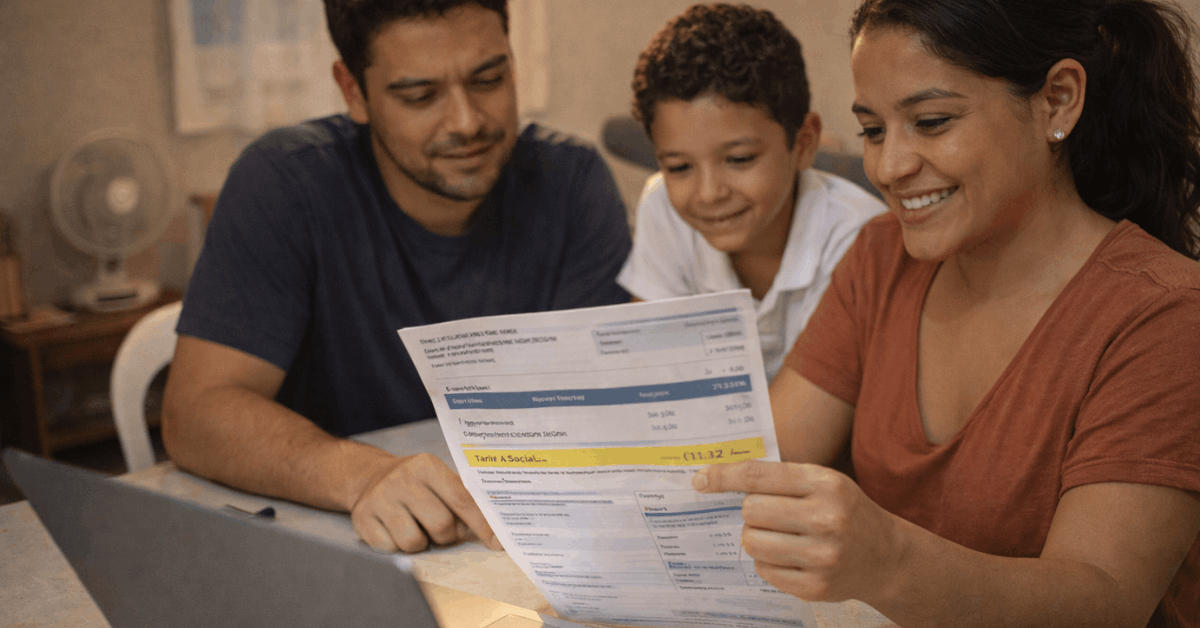
Confirmation that the discount is active typically appears directly on the electricity bill. The field that describes the tariff should show “Tarifa Social de Energia Elétrica” or an equivalent label, together with the reduced values for the eligible consumption bands.
Some companies also display the applied percentage and the savings compared with the conventional tariff.
Caixa Econômica Federal
Many distributors and Caixa Econômica Federal provide digital channels such as official apps or websites where families can check eligibility status and active benefits. Regular monitoring helps detect problems early, such as sudden disappearance of the discount or incorrect classification of the tariff.
CadÚnico Registration
Long-term access depends on maintenance, not only initial approval. CadÚnico registration must be reviewed at least every two years, or sooner when income rises or falls, family members move out or in, or the household changes address.
Families that move must request update of the account holder data and possibly reapply at the new location, keeping CadÚnico registration aligned with the new bill.
Other Benefits Linked To CadÚnico Registration
CadÚnico registration opens the door to several social policies beyond electricity. The Social Electricity Tariff often operates alongside other programs designed to stabilize basic expenses. Keeping data current becomes a practical way to access coordinated support for essential services.
Key examples include:
- Auxílio Gás, which supports the purchase of cooking gas for low-income families according to federal rules.
- Bolsa Família beneficiaries, who receive direct income transfers and often qualify automatically for electricity discounts when consumption limits are respected.
- Tarifa Social de Água or equivalent local policies, where municipal or regional water utilities grant discounts for CadÚnico households.
- Combined benefits create a broader protection network for food, energy, and water, especially in households exposed to unemployment or informal work cycles.
Common Problems and How To Solve Them
Errors in documentation and registration represent the main obstacles to approval. Many rejections come from expired CadÚnico files or income information that no longer reflects the real situation.
Inconsistent spelling of names between documents, CadÚnico, and the bill holder also generates system mismatches that block automatic recognition. Another frequent problem occurs in homes that host more than one family.
Single Social Electricity Tariff
Only a single Social Electricity Tariff benefit can apply per installation, which means relatives sometimes dispute who should appear as the main account holder. Clear internal agreements and transparent registration reduce these conflicts and prevent unnecessary rejections.
Practical solutions usually start at CRAS and the distributor’s service channels. Updating CadÚnico data, correcting CPFs, and aligning the name on the bill with the official registry tend to resolve most cases.
Digital copies of documents stored securely on a phone or cloud service make renewals faster and help when the family needs to prove eligibility again after moving or changing circumstances.
Digital Tools and Future Improvements
Utilities increasingly invest in digital tools that connect directly with social tariffs. Official apps allow families to monitor monthly consumption, view applied discounts, download bills, and confirm whether the Social Electricity Tariff remains active.
Some systems send notifications when CadÚnico registration approaches the two-year update deadline, which helps prevent benefit suspension. Federal and state authorities also discuss expansions that complement the classic discount structure.
Recent laws created a Desconto Social for families in CadÚnico with per capita income between half and one minimum wage, offering reduced tariffs up to 120 kWh in many concession areas. Debates around distributed generation and solar energy appear as part of broader strategies to support low-income consumers and encourage efficient, cleaner energy use.
Practical Energy Saving Tips For Low-Income Homes
Even when the Social Electricity Tariff applies correctly, small changes in daily habits can keep consumption inside the most favorable discount bands.
Efficient use of appliances protects the monthly budget and improves the impact of every subsidy received. Energy-saving routines work best when all family members understand the rules and cooperate.
Consider practices such as:
- Replace incandescent bulbs with LED lamps, starting with rooms used more often.
- Unplug televisions, chargers, and other electronics when not in use to avoid standby consumption.
- Prefer fans over air conditioners whenever the climate allows comfortable temperatures indoors.
- Wash clothes in full loads, selecting economical cycles, instead of multiple small washes.
- Take advantage of early morning or late afternoon ventilation to reduce the need for artificial cooling and lighting.
Combining these measures with the Social Electricity Tariff discounts often keeps monthly use below 220 kWh, which maintains the full benefit structure for most low-income homes.
Last Thoughts
The Social Electricity Tariff stands as a central piece of Brazil’s energy and social policy for low-income households. Properly applied discounts protect families against disconnection, support safe food storage, and keep phones, radios, and internet devices functioning for work and education.
The program also contributes to broader goals of energy poverty reduction and fair access to essential public services. Correct CadÚnico registration, organized documents, and regular updates are the practical steps that keep this benefit active.
Sharing information through churches, community centers, and neighborhood associations helps more households qualify and maintain the discount. When combined with other social programs and simple efficiency habits, the Social Electricity Tariff becomes a stable form of electricity bill assistance for those who need it most.